The Convergence Phase: A Testnet v0.1 Retrospective
Looking back at the first version of the unified Logos stack.

On 30 June, Logos Testnet v0.2 went live, bringing improvements across the stack and allowing operators to run all core modules from a single node.
To get started with the latest version of the Logos testnet, check out the new node operator guide and download Basecamp.
With this next phase of the testnet now being rolled out, it is worth looking back on the first Logos testnet release and examining its success in bringing the stack together as a unified whole.
Testnet v0.1 was the point at which the core Logos protocols stopped being independent projects and started being a single, live network.
Let’s take a look at what that convergence entailed, where it sits in the development roadmap, the data the network produced, and the issues it surfaced.
From independent protocols to a unified stack
For years, components of the Logos stack were developed as separate projects, although they were always aligned towards the same goal: to build privacy-preserving infrastructure to revitalise civil society and enable parallel societies.
These components include Logos Blockchain, a privacy-preserving proof-of-stake chain built on Cryptarchia consensus; Messaging, which provides end-to-end encrypted, metadata-protecting communication; and Storage, a decentralised file-sharing system with CID-based retrieval.
Each was designed from the outset to interoperate, but after the consolidation of the Logos stack, these components became modular elements of the same underlying infrastructure.
Testnet v0.1, launched in March 2026, was the milestone that saw the various elements of the stack converge. It marked the first time these protocols were shipped together as one unified, modular system rather than components on separate release schedules.
Architecturally, the stack is organised into distinct layers. At its foundation sits liblogos, a runtime responsible for the minimal primitives required to install and load Logos modules. Above it, the networking layer handles peer discovery, connection management, and privacy-preserving routing. On top of that sit the modules themselves, such as Blockchain, Chat, Delivery, and Storage. Each module is a pluggable component that communicates through well-defined interfaces exposed by the core runtime.
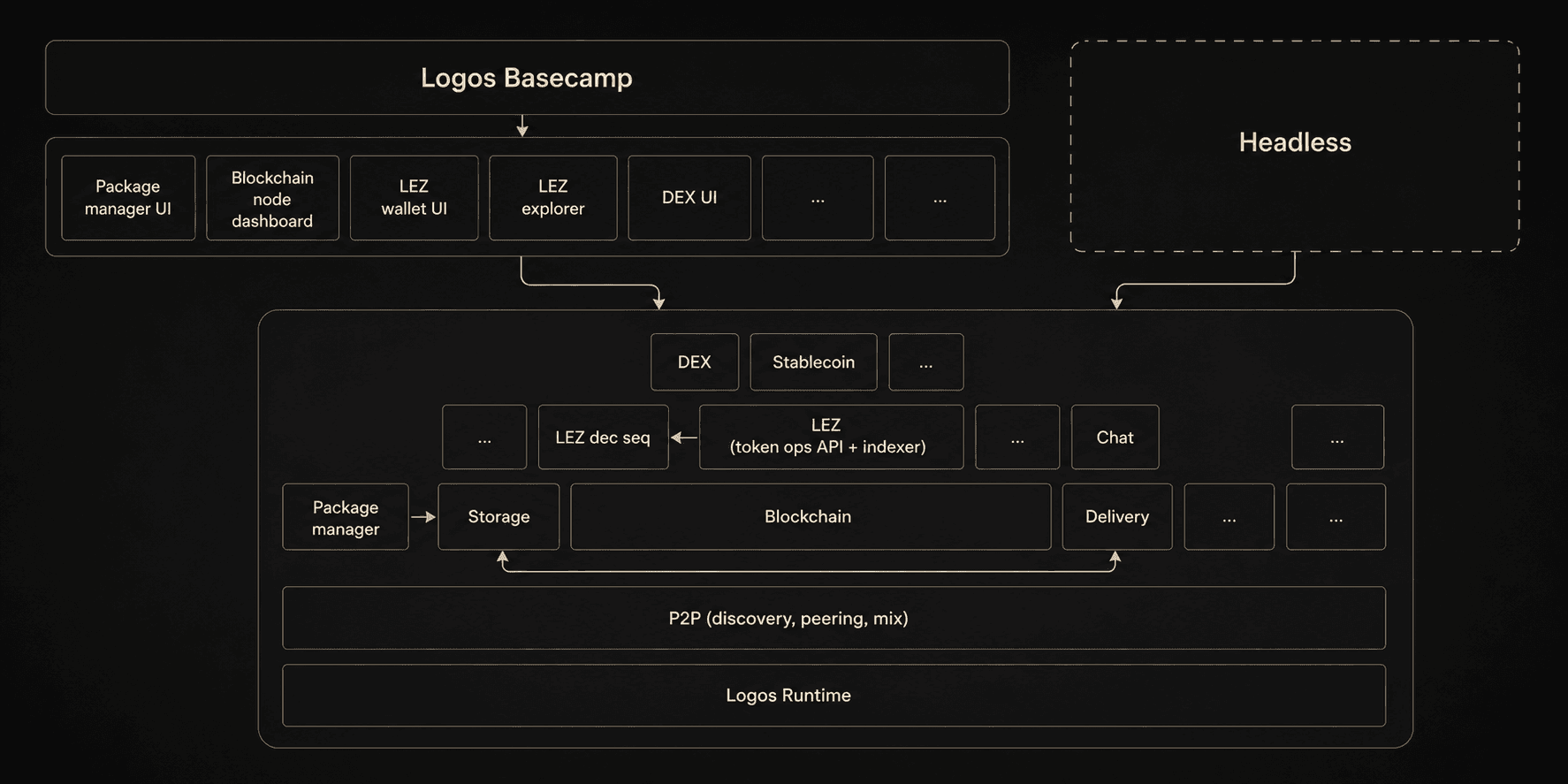
Basecamp offers a user-facing, self-contained desktop application that bundles the kernel, default modules, and UI packages into a single distribution, while node operators can run the same stack headless.
It is important to note that the goal of testnet v0.1 was this convergence, and the primary goal of testing was to ensure the feasibility and performance of the unified stack architecture. Its purpose was architectural validation: proving that independently developed protocols could operate as a coherent whole, exposing APIs under real network conditions, and stress-testing the interfaces between layers.
The scope was deliberately backend-first, prioritising infrastructure over polished UX or stability. The question that mattered was not whether the stack felt finished but whether the architecture held.
To give builders something concrete to test against rather than raw APIs alone, two sample applications shipped with the network. These included atomic swaps, demonstrating trustless cross-module exchange, and a multisig wallet, demonstrating private multi-party authorisation using threshold signatures and zero-knowledge proofs.
Testnet v0.1 and the road to mainnet
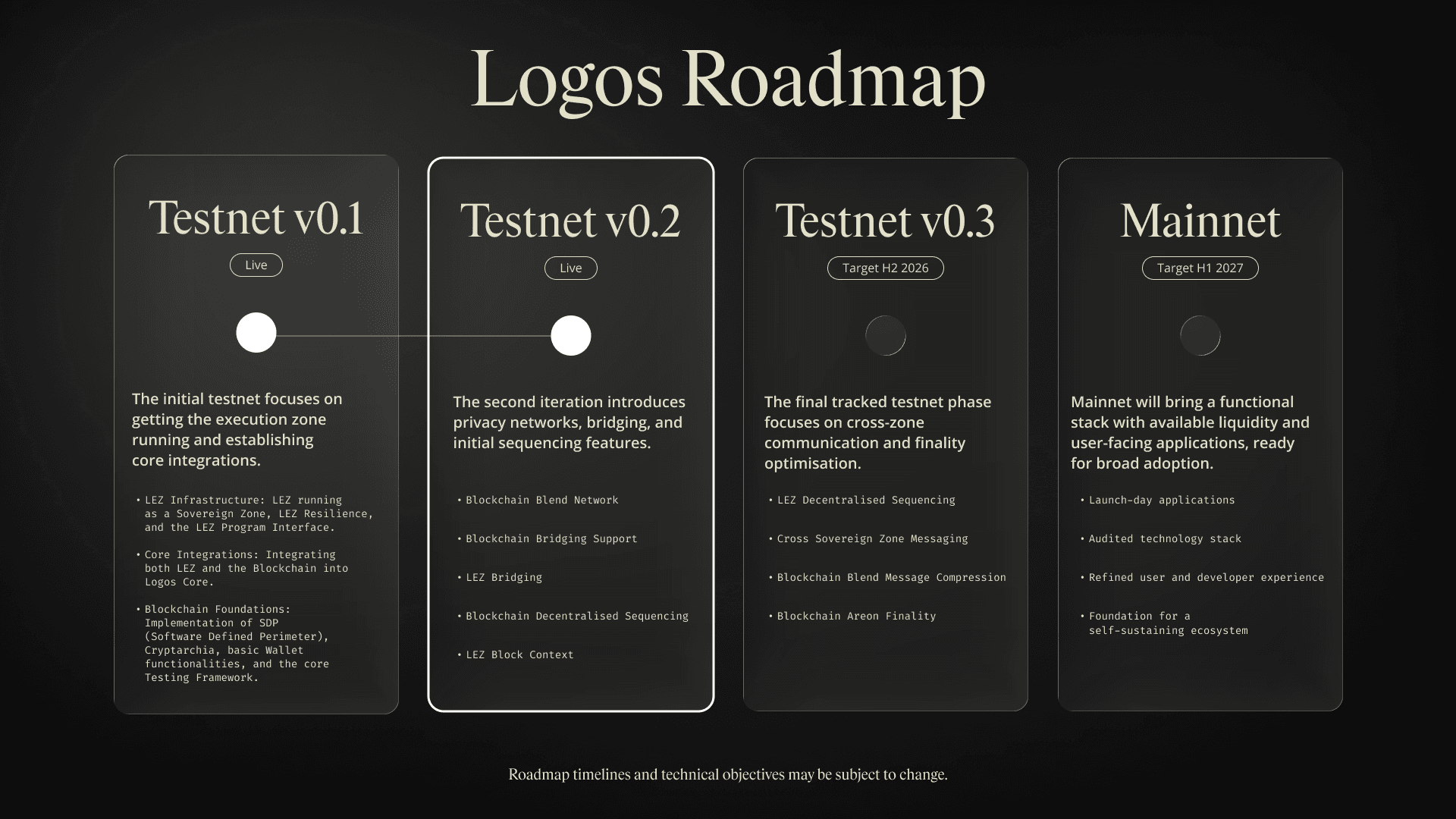
The development of Logos follows a staged path to mainnet, with each release answering a different question about the system. You can find an overview of the roadmap at roadmap.logos.co.
v0.1 – Architectural validation
Can the core protocols run as one unified stack? This phase converged the modules, exposed the APIs, and verified end-to-end system behaviour under real network conditions.
v0.2 – Hardening and interoperability
Now live, this phase extends the validated architecture with its intended privacy and decentralisation properties. Mechanisms such as proposer privacy via the Blend Network, decentralised Zone sequencing, and token bridging to and from zones have been deployed and are being hardened on the testnet. Alongside this, development also focuses on delivering a more unified operator and builder experience.
v0.3 – Ecosystem dynamics
The next phase of the Logos testnet will shift focus from the deployment of foundational infrastructure to the behaviour of the ecosystem built on top of it.
Mainnet – System viability
Upon mainnet launch, Logos will demonstrate a production network working at scale, with its modular architecture and privacy-preserving protocols hardened and proven viable.
The performance of Testnet v0.1
A small note before we look at some of the data from the first phase of the Logos testnet: Cryptarchia, the consensus protocol underpinning the Logos Blockchain, is designed so that block proposers and node operators cannot be identified or tracked directly.
Privacy is a property of the consensus layer itself, and that design decision constrains how the network can be measured, and the constraint is itself informative.
For this phase, the team used IP addresses as a privacy-respecting proxy for participation, derived from gossip logs in which nodes self-report their peer IDs. This yields a defensible picture of aggregate participation without attributing activity to any individual operator.
The figures below are therefore honest approximations – and the fact that nothing more granular is possible is a direct consequence of the privacy guarantees the network exists to provide.
Participation
Data for testnet v0.1 was logged during both the deployment of the initial release (v0.1.1) and the later update (v0.1.2).
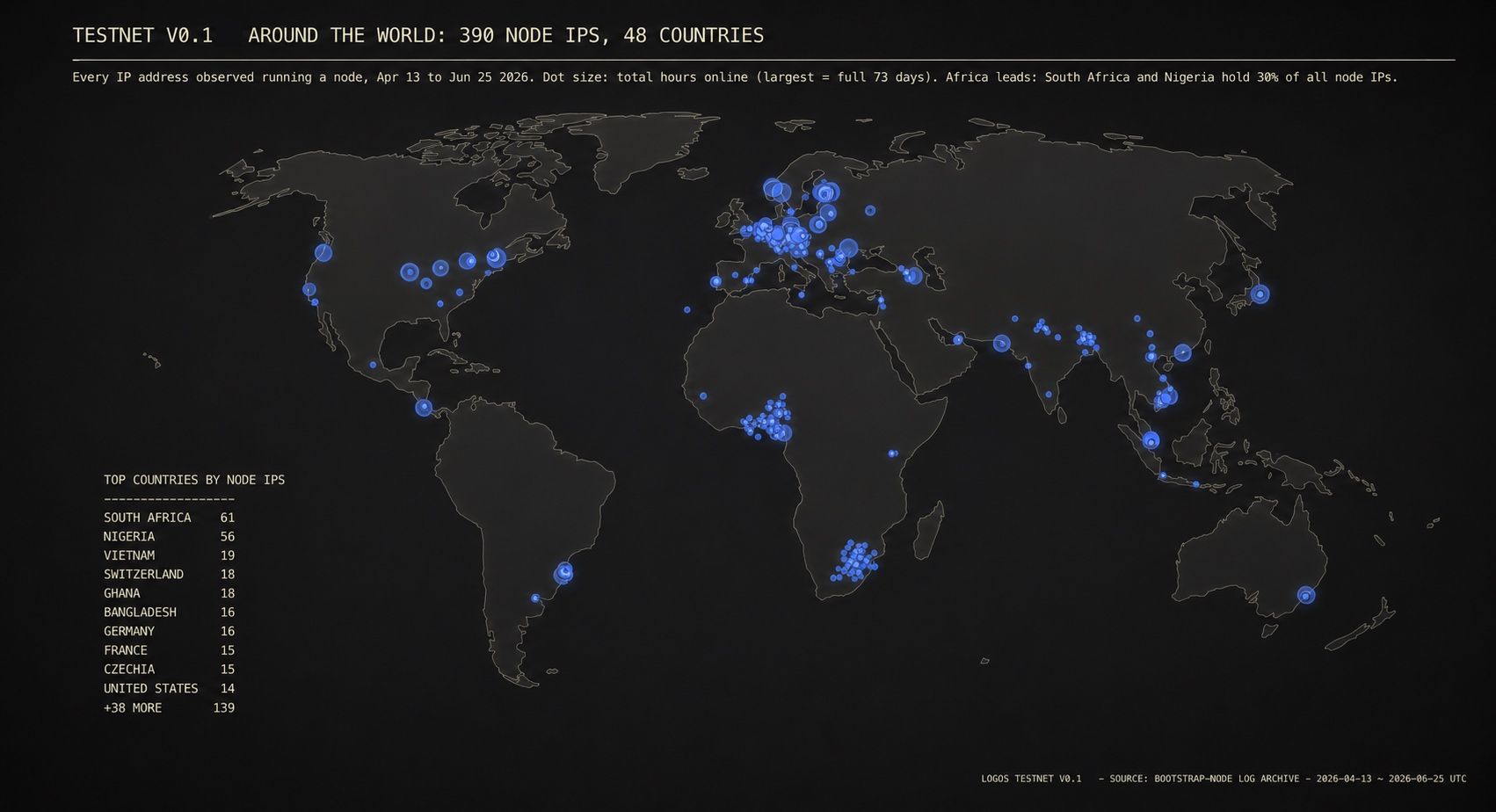
During the testnet v0.1.2 phase, we saw more than 390 distinct IPs operate nodes on the network. Distribution of the nodes was centred around South Africa and Nigeria, with these countries accounting for 30% of all node IPs. In total, node operators spanned 48 countries.
Uptime
Tracking during the initial phase of the v0.1 testnet showed most nodes remaining online for the majority of the observation window, with several larger operators running clusters of nodes continuously. For an experimental network offering no incentives beyond participation itself, that persistence is a meaningful signal about the operator community and the reliability of the network architecture.
Uptime was interrupted when the testnet v0.1.2 release was shipped, which brought several improvements and fixes identified in this early release.
Consensus and block production
The longest chain comprised 186,644 blocks over 984.3 hours of runtime, with an average block time of 19.0 seconds against a 20-second protocol target.
The slight downward drift from target was expected and acceptable, reflecting the overhead that real network conditions introduce relative to idealised parameters.
Transaction activity
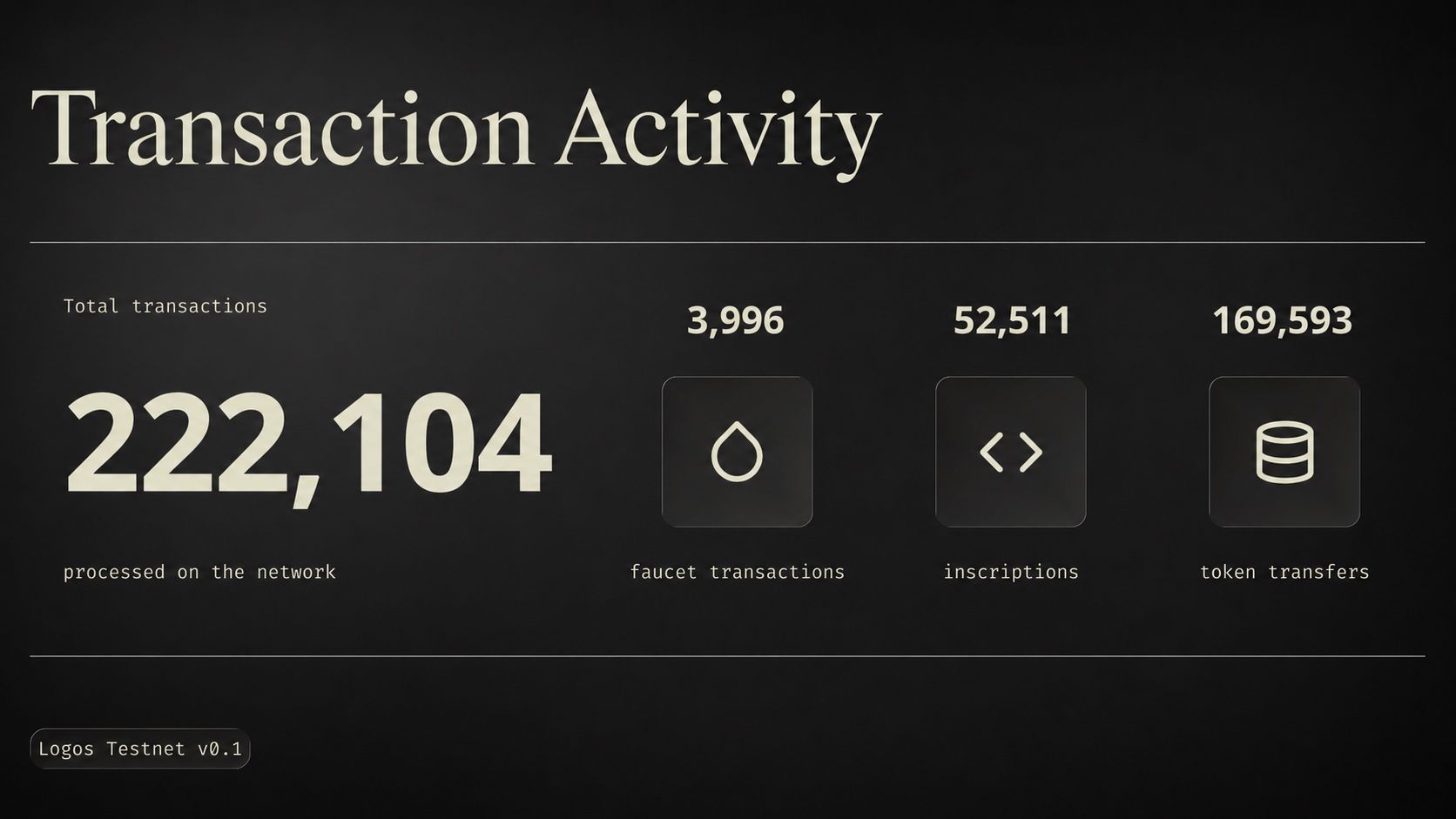
During the initial phase of the testnet, the longest chain saw 222,104 transactions processed on the network, including 3,996 faucet transactions, 52,511 inscriptions (dominated by the Logos Execution Zone, which publishes inscriptions to its channel at one-minute intervals) and 169,593 token transfers.
Mean transaction density across populated blocks was four transactions per block, with a p99 of 70 transactions per block recorded during two stress tests. The network was able to absorb both of these throughput spikes without disruption.
Applications
Alongside the atomic swaps and multisig demo applications delivered during this early testnet release, community builders put the stack through its most time-honoured integration test: a working port of DOOM running on Logos Basecamp.
Fixes and improvements to testnet v0.1
Validation of the converged Logos stack was the key goal of this release, and there were two major issues identified and quickly addressed with the release of the testnet v.0.1.2 patch.
The first was bootstrapping. A node joining the network, or rejoining after downtime, must sync to the chain tip by downloading and verifying historical block data. In the early version of testnet v0.1, this process was inefficient and non-restartable: an interrupted bootstrap forced operators to begin again from genesis.
As the chain lengthened, the cost compounded, and by the end of the run, bootstrap times exceeded 48 hours and consumed upwards of 20GB of RAM for some users.
The second issue identified during this phase was an anomaly with log volume. Nodes were writing log files at a rate of several GB per day, which produced cascading failures on constrained hardware such as personal machines and Raspberry Pis, filling their storage and potential leading to a corrupted node database state.
The response was v0.1.2, an update launched on 14 April with a new genesis block, requiring operators to clear node data before rejoining the network. It resolved the bootstrap and log-volume issues and improved chain recovery and Docker deployment.
The relaunch also enabled a deliberate experiment: redistributing stake across the network to observe block production under more even distribution – groundwork that fed directly into the design of testnet v0.2.
Testnet v0.2 is now live
If testnet v0.1 was about bringing Logos protocols and technology together into a unified, modular stack, v0.2 is about deploying and hardening the privacy-preserving protocols and modules that deliver the design philosophy of the infrastructure.
Testnet v0.2 delivers proposer anonymity via the Blend Network, decentralised sequencing for Zones, token bridging to and from Zones, and a substantially more unified experience for operators and builders.
Most importantly, convergence is a continuous process. With the v0.2 testnet release, Logos node operators can now run blockchain, messaging, and storage modules from a single node - allowing them to participate in other core elements of the stack, such as the Blend network.
The full changelog is available on the Logos Blog and in the release notes.
The easiest way to dive into Logos Testnet v0.2 is Basecamp: download it, load the modules you want to run, and stand up your own, local-first infrastructure in minutes.
We're building infrastructure to revitalise civil society. We need developers, designers, writers, and activists to help shape it.